

The Hidden Cost of Specialist-Dependent Platforms
For many organisations, the CMDB has become fundamental infrastructure.
So how do you know when confidence in your CMDB should be questioned? Here are five warning signs.
Your CMDB might be running perfectly. Your dashboards might be green. Discovery jobs might be completing. Configuration Items might be flowing into the platform every day. But none of that necessarily answers the question that really matters: Can you trust the data?
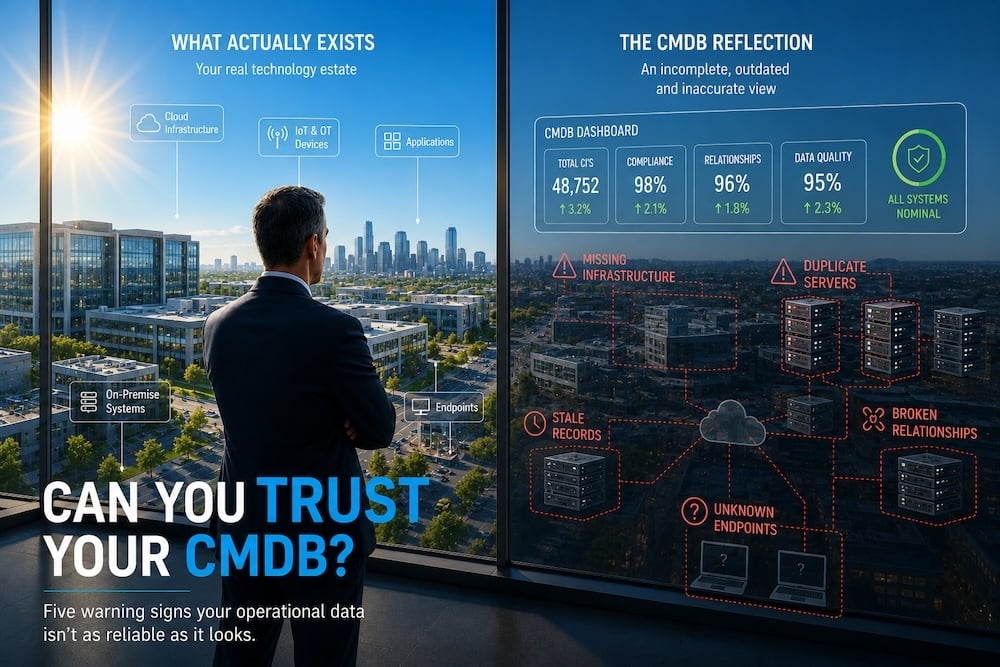
For many organisations, the CMDB has become fundamental infrastructure. IT operations, incident management, change, service mapping, compliance, automation and increasingly AI all depend on the information it contains. When that information is incomplete, duplicated, stale or disconnected from the services the business actually runs, the consequences extend far beyond the CMDB team. And the financial impact of poor, low-quality data shouldn't be underestimated.
Gartner estimates that poor data quality costs organisations at least $12.9 million per year on average, while identifying inconsistency between different data sources as a particularly significant data-quality challenge. So how do you know when confidence in your CMDB should be questioned? Here are five warning signs.
Warning Sign #1: Different Systems Tell You Different Things
Ask three systems how many servers you have. Do you get three different answers? Discovery says one thing. Your CMDB says another. Asset management has another figure. Then somebody produces a spreadsheet containing something different again. This isn't unusual.
Operational data naturally becomes distributed across discovery platforms, ITSM systems, monitoring tools, cloud platforms, security products and asset repositories. Operational data becomes fragmented, duplicated and inconsistent over time, eventually undermining operational trust. As discussed in our recent blog, the hidden cost of duplicate data is a business risk in its own right.
Lansweeper describes maintaining an accurate IT asset inventory as one of IT's most challenging jobs because devices and users continually change and manually maintained information rapidly becomes outdated. The problem isn't necessarily that one system is "wrong". It's that you don't know which one is right. When teams spend meetings debating whose numbers are correct, you don't have a technology problem anymore. You have a trust problem.
Warning Sign #2: Duplicate, Orphaned and Stale CIs Are Becoming Normal
Duplicates aren't just untidy records. Neither are stale or orphaned CIs. They're evidence that the representation of your technology estate is beginning to diverge from the estate itself. ServiceNow explicitly treats duplicates, orphan CIs and stale CIs as measures of CMDB correctness within CMDB Health. Its current CMDB Health framework also measures completeness, compliance and relationship quality. ServiceNow even provides peer and global benchmarking for the percentage of duplicate, stale and non-compliant Cis within CMDB environments. That tells us something important. These aren't edge cases. They are fundamental indicators of whether CMDB data can be trusted. A server that has disappeared shouldn't remain indefinitely. The same device shouldn't exist several times because different sources describe it differently. And an asset shouldn't become disconnected simply because its relationship information hasn't kept pace with infrastructure change. The question isn't whether bad records exist. It's whether you can identify, reconcile and correct them continuously.
Warning Sign #3: Nobody Can Tell You What You're Missing
It's a business risk when a CMDB contains 100,000 Configuration Items, and no one knows how many it should contain. Without knowing the answer, a large CMDB can create an illusion of visibility. One of TekWurx's financial-services engagements demonstrates how dramatic the difference can be. At an international stock exchange, the existing discovery implementation was finding only 7% of the expected assets. Following TekWurx's work, discovery coverage increased to 98%, creating a significantly more comprehensive operational picture. That's the distinction between volume and coverage. A CMDB containing millions of records isn't necessarily comprehensive. You need independent ways of identifying what discovery isn't seeing.
That's one reason uControl Insights extends discovery across IT, OT, IoT and cloud environments and includes capabilities such as passive network-flow discovery, dark-space and shadow-IP detection, and self-seeding scan targets designed to expose infrastructure that conventional scanning can miss. Because you can't manage what you can't see. And you certainly can't trust a CMDB if you don't know what's absent from it.
Warning Sign #4: Your Relationships Don't Reflect the Business
Knowing that a server exists is useful. Knowing what depends upon it is considerably more valuable. This is where many CMDBs can struggle. Infrastructure gets discovered, but relationships between applications, databases, infrastructure, cloud resources and business services either aren't captured accurately or deteriorate as the environment changes.
ServiceNow recognises relationship health as a specific component of CMDB health, testing areas including orphan and duplicate relationships as well as whether relationships comply with expected hosting and containment rules. Why does that matter? Because without trustworthy relationships, impact analysis becomes guesswork. A technical team might know that a server is changing on Saturday night. What they really need to know is: Which business services could be affected if it fails?
This is why uControl goes beyond simply discovering infrastructure. uControl Core is designed to ingest and reconcile operational data, model services and provide service context so that organisations can understand not simply what exists, but how their technology supports the business.
For one international bank, TekWurx used uControl to model 633 service applications and approximately 1,500 application instances, capturing environments and dependencies and enabling the organisation to achieve 100% of its DORA compliance requirements within one working week. That's the difference between an inventory and an operational model.
Warning Sign #5: People Have Built Workarounds Around Your CMDB
The most frequent, the most concerning of all the warning signs that we encounter, and the greatest risk to a business is when people stop complaining about the CMDB. Instead, they quietly stop using it.
Teams create spreadsheets. Engineers maintain their own inventories. Service owners keep separate application lists. Consultants perform new discovery exercises because they don't trust existing information. Critical knowledge becomes concentrated in the heads of a handful of experienced employees. At that point, the organisation may technically still have a CMDB. Operationally, however, it no longer has a single source of truth.
During TekWurx's Federal Reserve Bank discovery migration, the organisation faced a high volume of pre-existing ServiceNow CMDB data and considerable variation in naming conventions. TekWurx analysed and rationalised the existing data and delivered an environment maintaining 99.9% CMDB data accuracy, while the wider programme eliminated more than £1 million in costs and inefficiencies. The lesson isn't that every organisation should chase an arbitrary percentage. It's that trust has measurable operational value.
A Healthy CMDB Isn't Static
The biggest mistake organisations make is treating CMDB quality as a project when technology estates don't stand still. Cloud resources appear and disappear. Applications change. Servers move. Software gets installed. Infrastructure is retired. Ownership changes. Relationships evolve.
The question shouldn't be: “Was our CMDB accurate when we implemented it?”
The right question is: “How do we know it's accurate today?”
That's a fundamentally different challenge. Beyond operational efficiency, it's a fundamental question to the implementation of an AI strategy. In our recent blog, we discussed that AI will only succeed on the basis of trusted operational data.
From CMDB Accuracy To Operational Trust
This is the problem uControl was designed to address. uControl Core takes the next step: ingesting, normalising and reconciling operational information, modelling services and creating trusted context around the data.
uControl provides a way to continuously challenge, validate and improve the operational truth your IT organisation depends upon. That becomes increasingly important as enterprises introduce automation and AI into IT operations. An AI system can analyse bad operational data faster. It can automate decisions based upon it faster. But it cannot magically make that data trustworthy.
Can You Trust Your CMDB?
There's a simple test.
Ask your team five questions:
- Do all our operational systems agree about what we own?
- Can we identify duplicates, stale records and inconsistencies automatically?
- Do we know what our discovery tools aren't finding?
- Can we reliably connect infrastructure to the applications and services it supports?
- Do our teams actually use the CMDB, or have they built spreadsheets and workarounds around it?
If any of those questions are difficult to answer, your CMDB may not be the source of truth you think it is. Before investing in another transformation programme, automation initiative or AI platform, there is a more fundamental problem worth solving:
Can You Trust The Operational Data Beneath It?
uControl can independently discover, reconcile and validate your operational estate, exposing gaps, duplicates and inconsistencies before they become operational problems. Book a 30-minute uControl demonstration to see how quickly it can establish a trusted operational data set in your business.