

The Hidden Cost of Specialist-Dependent Platforms
Duplicate operational data quietly drives up IT costs, delays decisions and undermines AI adoption.
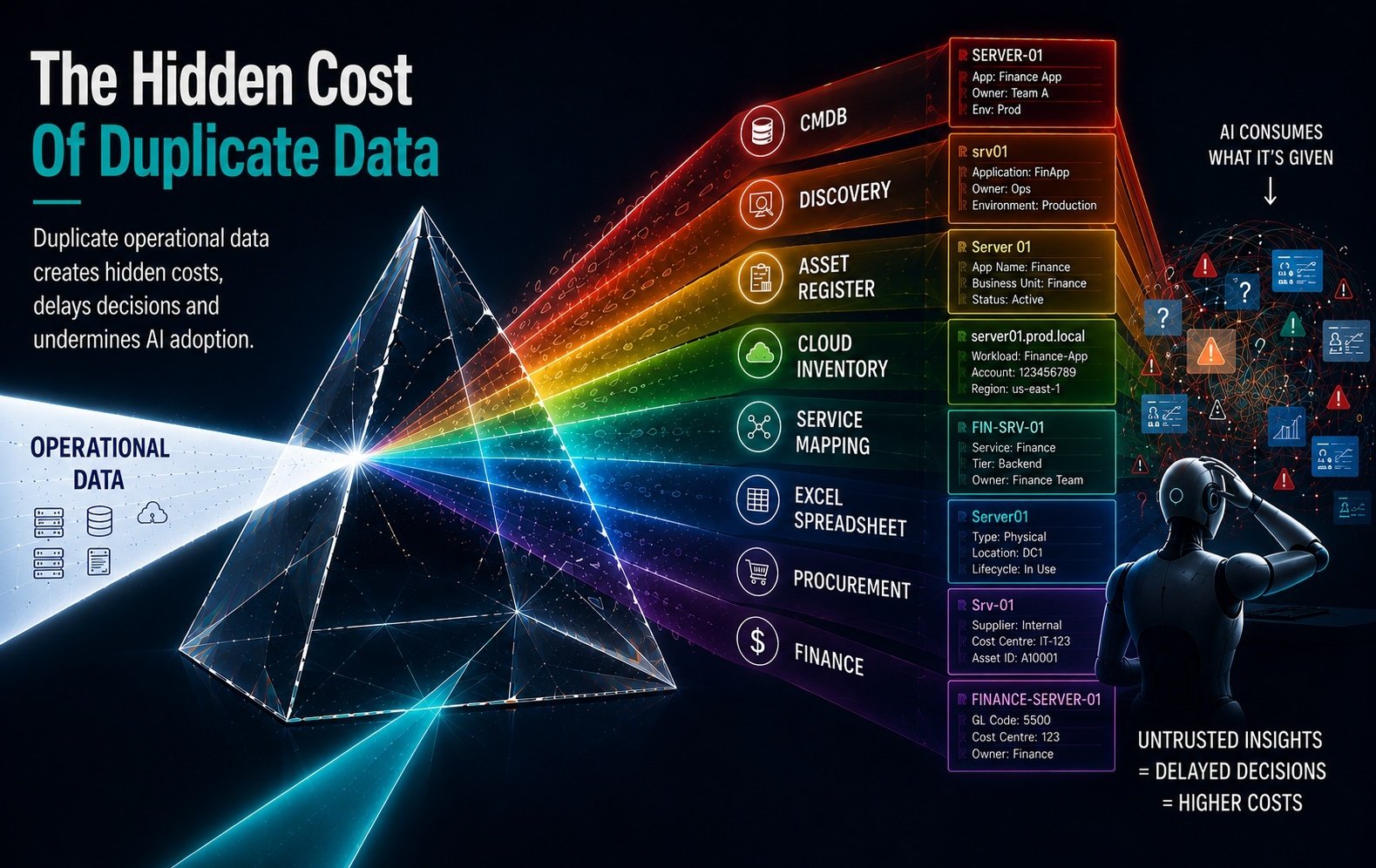
Most organisations recognise duplicate data as an inconvenience. Few recognise it as one of the largest hidden costs in enterprise IT. Duplicate operational data rarely exists in isolation. It creates conflicting records, inconsistent relationships and multiple versions of the truth across discovery platforms, CMDBs, ITSM solutions and asset repositories. Over time, operational data can become fragmented, duplicated and inconsistent, making it increasingly difficult for organisations to trust the information they rely on every day. The consequences extend far beyond data quality.
The Cost Of Duplicate Data In Man Hours
Weak operational data creates an invisible tax on every technology programme. Highly skilled architects, infrastructure specialists and service owners are pulled away from strategic work to reconcile conflicting information. Teams maintain temporary spreadsheets because no single platform can be trusted. Projects slow down while stakeholders debate which dataset is correct rather than acting on the information available. External consultancy may fix the problem at a cost in the short term, only for a the same issues to arise again in few short months.
Integration programmes can often become dependent on a handful of individuals who understand years of legacy systems, naming conventions and undocumented relationships. Those people become operational bottlenecks and single points of failure.
This is the hidden labour cost of duplicate data. It rarely appears on a balance sheet, yet it quietly consumes thousands of hours every year. To operate successfully and efficiently, the objective isn't as simple as consolidating everything onto a single ITSM platform or implement another CMDB. Operational efficiency is achieved when the organisation creates a trusted, shared operational model that everyone can rely upon.
AI Won't Rescue An Untrusted Technology Estate
IT leaders are increasingly driven to adopt artificial intelligence, to improve operational analysis, automate repetitive tasks and accelerate decision-making. However, AI doesn't solve poor data quality. It amplifies it. If duplicate, inconsistent or conflicting operational data exists today, AI will consume that same data and generate insights based upon unreliable information.
Gartner predicts that through 2026, organisations will abandon 60% of AI projects unsupported by AI-ready data. Gartner also found that organisations achieving successful AI initiatives invest up to four times more in foundational capabilities such as data quality, governance, AI-ready skills and change management, than organisations with poor AI outcomes.
The lesson is simple: successful AI starts with trusted operational data.
Building A Trusted Operational Foundation Is Fundamental To AI Success
At TekWurx, we've seen these challenges repeatedly across complex enterprise environments. Whether helping a Federal Reserve Bank migrate discovery platforms while maintaining 99.9% CMDB accuracy and eliminating over £1 million in operational costs and inefficiencies, or delivering automated service mapping for an international bank to achieve 100% DORA compliance, success always begins with establishing trusted operational data before building automation on top of it.
uControl ingests, reconciles and normalises operational data from multiple sources to create a trusted operational model that people, processes, and AI can confidently consume. uControl continuously validates, models and governs operational data to maintain trust over time. It helps IT leaders maximise their existing tooling, rather than endure the cost and uncertainty of ripping it out and replacing it. Book a 30-minute demonstration of uControl to understand the value that it could drive from your existing tooling.
Duplicate Data Is More Than Just An Operational Cost
It’s also a technical inconvenience, a productivity drain, a compliance issue and an AI-readiness problem. Organisations that eliminate duplicate operational data don't just improve their CMDBs. They reduce labour costs, accelerate decision-making, remove dependency on key individuals and create the trusted operational foundation that modern IT (and AI) depend upon.