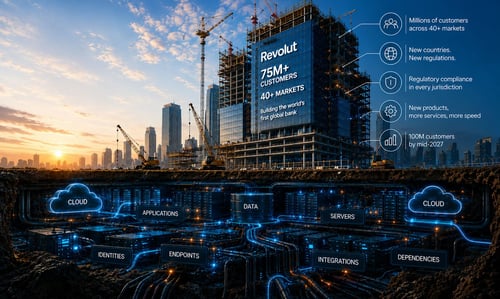

The Real Cost Of AI: What Alibaba’s $10bn Quarter Should Tell Every CIO.
Buying The Technology Is Only The Beginning.
The real question for IT leaders, is what it costs to keep extracting value from it?
The technology industry is in the middle of one of the biggest investment cycles in its history. Artificial intelligence is driving extraordinary levels of spending on infrastructure, software, data centres, cloud capacity and specialist expertise. The world's largest organisations aren't simply experimenting with AI anymore. They're placing enormous strategic and financial bets on it.
This week SoftBank provides perhaps the clearest illustration. Chief Executive Masayoshi Son has argued that AI development could eventually require $5 trillion of investment every year by 2040. SoftBank itself has committed tens of billions of dollars across OpenAI, AI infrastructure, robotics and related technologies.
Alibaba offers another example. It has committed RMB380 billion, approximately $56 billion, to AI infrastructure between 2026 and 2029. Read the full story.
Across the hyperscale market, the numbers are even larger. JLL estimates that Google, Microsoft, Meta and Amazon will collectively spend around $725 billion during 2026, much of it on AI computing and data-centre infrastructure.
Underneath the headline investment figures sits another question. What happens after the technology has been bought? Total Cost of Ownership doesn't tell the whole story. Technology procurement has talked about Total Cost of Ownership (TCO) for decades.
The calculation normally considers software licences, infrastructure, implementation, maintenance, support, upgrades and associated operational costs. There is another cost that deserves considerably more attention. Consider what the organisation must continue spending annually simply to extract the outcome that justified the investment in the first place.
A platform may have been successfully implemented. It may technically “work”. It may even deliver impressive capabilities. But if every significant configuration change requires a specialist consultant, every new use case requires professional services, every integration requires scarce expertise and every upgrade creates another project, the organisation hasn't simply purchased technology. It has purchased an ongoing dependency. And that dependency can become expensive.
The Specialist Dependency Problem
This matters particularly across complex enterprise IT platforms. Discovery, CMDB, service mapping, ITSM, observability and asset-management technologies can be enormously powerful. Capability and accessibility aren't the same thing. If an organisation needs highly specialised people to configure, maintain and evolve a platform, the cost of obtaining value from it continues long after implementation. The consequences extend beyond consultancy invoices. Specialist dependency can create:
- Higher operating costs, as expensive expertise is repeatedly required.
- Slower time to value, because internal teams wait for specialist resources.
- Knowledge concentration, where critical capability sits with a handful of people.
- Operational bottlenecks, because change becomes dependent on those specialists.
- Reduced agility, because experimenting with new requirements carries additional cost.
- Value erosion, organisations eventually stop improving platforms that have become too difficult or expensive to change.
The original business case might therefore tell only part of the story.
The better question isn't simply: What will this platform cost us to own?
It is: What will it cost us to keep getting value from it?
Clients increasingly expect greater productivity, measurable outcomes and lower costs rather than simply paying for hours worked. That same challenge should now be applied to enterprise technology. If AI is supposed to eliminate inefficiency, organisations should be asking whether the platforms underneath it create unnecessary dependency themselves.
Technology Should Reduce Dependency, Not Institutionalise It
This principle sits at the heart of uControl.
uControl has been designed to give organisations visibility, trust, traceability and control across operational data without creating another platform that only specialists can operate.
uControl ingests, reconciles and governs operational information, allowing organisations to build trusted service context and maintain control as their environments change.
uControl Insights extends that approach into asset intelligence.
It can discover IT, OT, IoT and cloud environments and provide hardware, software, application and operational context across the estate.
But an important part of the proposition isn't simply what the technology can do. It's how easily organisations can use it. uControl Insights has been designed around a self-service journey.
A fresh environment can begin producing operational intelligence rapidly, with configuration handled through the product rather than requiring a professional-services engagement every time the organisation wants to move forward. That fundamentally changes the economics. From weeks to minutes
Traditional enterprise technology projects can take weeks or months before meaningful value reaches operational teams. uControl Insights has been designed around a different principle:
Minutes, not weeks.
Deploy the platform.
Connect credentials.
Select scan targets.
Run the scan.
Assets, topology and relationships begin appearing.
From there, uControl Insights can surface operational intelligence across the estate, including new and stale assets, software usage, lifecycle information, cost opportunities, certificate risk and other areas requiring attention.
The platform also incorporates AI directly into the operating experience, including natural-language interaction with inventory, AI-generated insights, risk scoring and scan diagnosis. The objective isn't simply to put another AI logo on another enterprise platform. It is to make complex operational intelligence easier for people to consume and act upon.
We Have Seen The Cost Of Dependency First-Hand
A global telecommunications enterprise working with TekWurx faced precisely this problem. The organisation operated a highly secure, air-gapped environment supporting critical customer infrastructure. Its existing asset-management platform had reached end of life and was increasingly difficult to maintain. Asset records were being manually updated. Operational overhead was increasing. Knowledge was concentrated around a single administrator. The organisation considered moving to a traditional Discovery and CMDB platform. But licensing costs, specialist skills requirements, ongoing support and the complexity of operating that technology inside a secure air-gapped environment made the economics difficult to justify.
TekWurx deployed uControl.
The result was a supported asset-management platform that reduced manual administration, reduced dependency on a single administrator and lowered operational overhead.
The organisation subsequently renewed uControl for a further three years. That is an important distinction. The value wasn't simply in deploying another piece of technology. It was in removing complexity from the operating model surrounding it.
Enterprise Experience Matters
TekWurx has repeatedly seen how specialist dependency affects large IT environments.
At a Federal Reserve Bank, a complex discovery migration had to be delivered within a 40-day licence renewal window. TekWurx completed the migration while maintaining 99.9% CMDB data accuracy and eliminating more than £1 million in costs and inefficiencies.
At a major international stock exchange, four previous partners had been unable to successfully complete a discovery migration. Asset coverage stood at just 7%. TekWurx ultimately increased discovered asset coverage to 98%.
And at an international bank facing DORA requirements, uControl enabled 633 service applications and approximately 1,500 application instances to be modelled, helping the organisation achieve its required compliance outcome within a working week.
These environments are complex.
Enterprise technology often has to be complex too. But complex technology doesn't have to create a complex operating model. That distinction will become increasingly important as organisations accelerate investment in AI.
The next technology business case needs another line
CIOs and technology leaders should continue calculating Total Cost of Ownership. But it is no longer enough. Every significant technology investment should also ask: What is our Cost of Value? A platform that promises automation but requires constant specialist intervention creates a contradiction. The technology may automate the business. But somebody still has to operate the technology.
The Technology Investment Race Is Just Beginning
The question facing enterprise technology leaders will therefore move rapidly from:
“Can we implement AI?”
to:
“Can we operate the technology estate behind it efficiently?”
Winning the race to deploy new technology is not enough. The winners will be the organisations that can continue extracting value without continually adding people, complexity and specialist cost. That's the philosophy behind uControl.
Enterprise capability without enterprise dependency.
Because the real cost of technology isn't simply what you pay to buy it.
It's what you have to keep paying to make it valuable.
Discover uControl and uControl Insights
Discover how uControl can give your organisation trusted operational data, complete visibility and greater control, without building another layer of specialist dependency into your technology estate.
Book a uControl demonstration today.