

The Hidden Cost of Specialist-Dependent Platforms
Operational Trust Is The Foundation Of Successful AI Strategies
Visibility Alone Isn't Enough.
Artificial Intelligence has become a priority item on the agenda of IT leaders this year. Whether it's automating service desks, improving incident response, predicting infrastructure failures or accelerating software delivery, organisations are investing heavily in AI to transform IT Operations. According to McKinsey, 78% of organisations now use AI in at least one IT function. Despite billions of pounds being invested in AI initiatives, one uncomfortable reality continues to emerge. Most IT teams don't have an AI problem, they have a data trust problem.
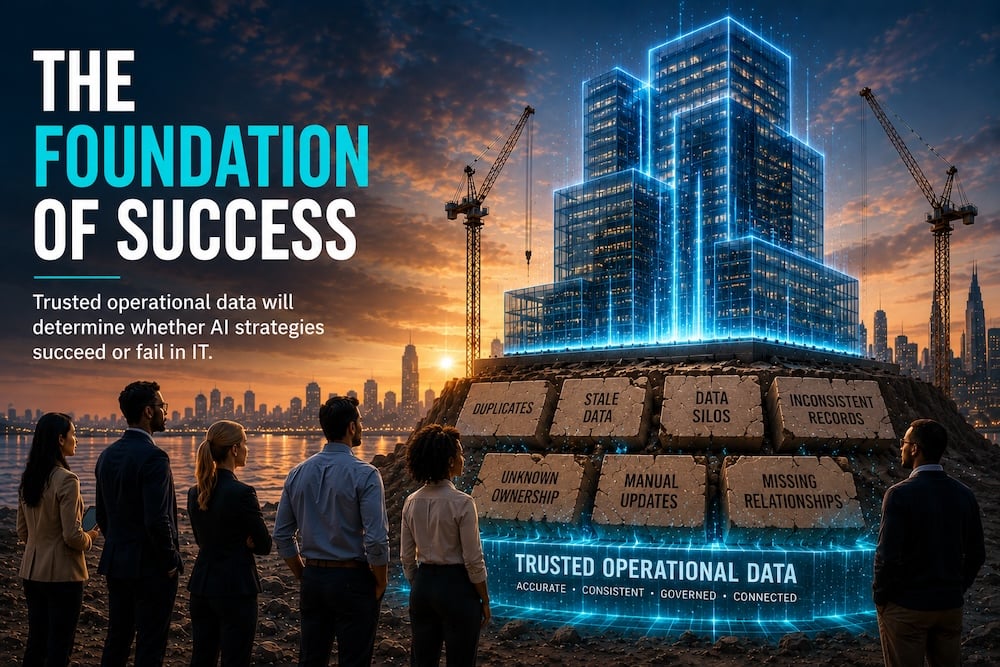
The AI Revolution Depends on Operational Data
Every AI platform relies on one fundamental principle: The quality of its output will never exceed the quality of the data it receives. In IT Operations, that data comes from dozens of different sources.
- Discovery platforms
- CMDBs
- Asset Management systems
- Cloud platforms
- Monitoring tools
- Security platforms
- Service Management systems
Collectively these systems describe how the organisation operates, but what happens when they all disagree?
85% of AI initiatives in IT fail to deliver their expected outcomes because of poor data quality, poor data availability or weak data governance (Gartner). The AI itself isn't failing, the data feeding it is. The challenge isn't that organisations lack operational information, it's that they no longer trust it.
Discovery Isn't The Problem
Enterprise discovery has been one of the great success stories in IT Operations. Solutions including ServiceNow Discovery and BMC Discovery have automated what was once a manual, time-consuming exercise. Today organisations can discover:
- Servers
- Cloud resources
- Network devices
- Applications
- Databases
- Software
- Infrastructure relationships
Discovery has solved the visibility problem. But visibility alone doesn't create confidence. Discovery answers one question exceptionally well. What exists? It doesn't answer equally important questions.
- Which source is correct?
- Is this data duplicated?
- Has this relationship changed?
- Is this application still owned by the right team?
- Can I automate decisions using this information?
- Would I trust AI to act on it?
Those are entirely different challenges.
Why So Many CMDB Programmes Lose Momentum
In an enterprise CMDB, discovery tools populate thousands (sometimes hundreds of thousands) of configuration items automatically. Dashboards appear. Reports improve. Coverage increases. Everything looks successful. Then something changes. Different discovery tools report different values. Cloud resources disappear and reappear. Application ownership becomes outdated. Infrastructure changes faster than governance processes. Manual updates introduce inconsistencies. Multiple data sources begin contradicting each other. Gradually confidence starts to disappear. The CMDB doesn't suddenly become inaccurate overnight. It simply becomes less trusted every week. Eventually business stakeholders stop relying on it. Projects that depend on trusted operational data begin to stall. Automation slows. AI initiatives pause. Service Mapping loses credibility. The technology wasn't the problem. Poor operational data destroyed confidence in the platform.
Visibility Alone Isn't Enough, AI Needs Trusted Operational Data
The operational reality inside many enterprises today is that, dashboards display infrastructure information. Every dashboard is populated. Every dashboard updates. Yet every dashboard reports a different answer to the same question.
The introduction of AI only exacerbates this issue, as it makes recommendations, it identifies risks, it proposes changes and increasingly it will automate actions based on inaccurate information.
If AI recommends rebooting the wrong server because of inaccurate CMDB relationships. If an AI-generated Service Map is built using stale discovery information. If software licence optimisation is based on duplicate assets. The consequences move beyond inconvenience. They become an operational risk. Which is why operational trust is becoming one of the most important strategic capabilities in enterprise IT.
Organisations continue to spend significant amounts of time reconciling inconsistent operational data rather than acting upon trusted insight. That manual reconciliation creates hidden operational cost while delaying the very automation AI was supposed to enable.
Introducing uControl
Rather than replacing discovery investments, uControl sits alongside them, continuously transforming fragmented operational data into trusted operational intelligence. uControl ingests information from multiple operational platforms before:
- Reconciling conflicting records
- Normalising inconsistent data
- Eliminating duplicates
- Maintaining trusted service relationships
- Detecting operational drift
- Continuously validating operational models
- Providing trusted service context for automation and AI
Instead of asking which discovery platform is correct, organisations finally have confidence in the answer. The platform is specifically designed to solve the Operational Data Problem, where fragmented, duplicated and inconsistent data gradually erodes confidence in IT operations.
Proven in Enterprise Environments
TekWurx has worked with enterprise discovery technologies since their inception, helping some of the world's most highly regulated organisations build trusted operational data foundations.
For a Federal Reserve Bank, uControl supported a migration from ServiceNow Discovery to BMC Discovery within a strict 40-day licensing window, while maintaining 99.9% CMDB accuracy. The project eliminated over £1 million in operational costs and inefficiencies. The success of the project depended not just on discovery, but preserving trust in operational data throughout the migration.
An international stock exchange tried to implement a discovery programme, but only identified only 7% of expected assets. After four unsuccessful implementation attempts, uControl helped transform coverage to 98%, enabling trusted service mapping, cloud integration and a CMDB that became a reliable foundation for operational decision-making.
More recently, an international bank used uControl to model 633 business applications, publishing 1,500 application instances and achieving 100% DORA compliance within five days, demonstrating how trusted operational data can support both regulatory compliance and business resilience.
The Future of AI Isn't Better AI
It's better data. Enterprise discovery programs have largely solved the challenge of finding technology. The competitive advantage won't come from discovering more assets. It will come from trusting the operational data that describes them. AI doesn't transform organisations. Trusted operational data does. That's why visibility alone isn't enough.
For more than twenty years, TekWurx has helped enterprise organisations maximise the value of discovery, CMDB and service management technologies. Today, with uControl we're helping customers take the next step: creating a trusted operational data foundation that enables automation, AI and confident decision-making. If your organisation is investing in AI but still questions the accuracy of its operational data, we'd love to show you how uControl can help. Book a personalised, 30-minute demonstration and discover how trusted operational data becomes the foundation for successful AI.