

The Hidden Cost of Specialist-Dependent Platforms
The Operational Data Problem:
Why Enterprises No Longer Trust Operational Data
For years, enterprises have invested heavily in Discovery, CMDB, ITSM, monitoring, observability and asset management platforms. Yet despite spending millions on technology, many IT leaders still ask the same question: "Can we actually trust the data?"
This is the operational data problem, it isn't that organisations lack data, they have more operational data than ever before. The problem is that it exists across dozens of disconnected platforms, each maintaining its own version of reality. Over time those versions drift apart until nobody can confidently answer simple questions such as:
- What assets do we actually own?
- Which business service does this server support?
- Which applications will this change affect?
- Is our CMDB still accurate?
- Can we trust this data enough for audit, automation or AI?
When trust disappears, every downstream process becomes slower, more expensive and more risky. Enterprise operational data naturally becomes fragmented, duplicated and inconsistent over time, causing operational trust to break down.
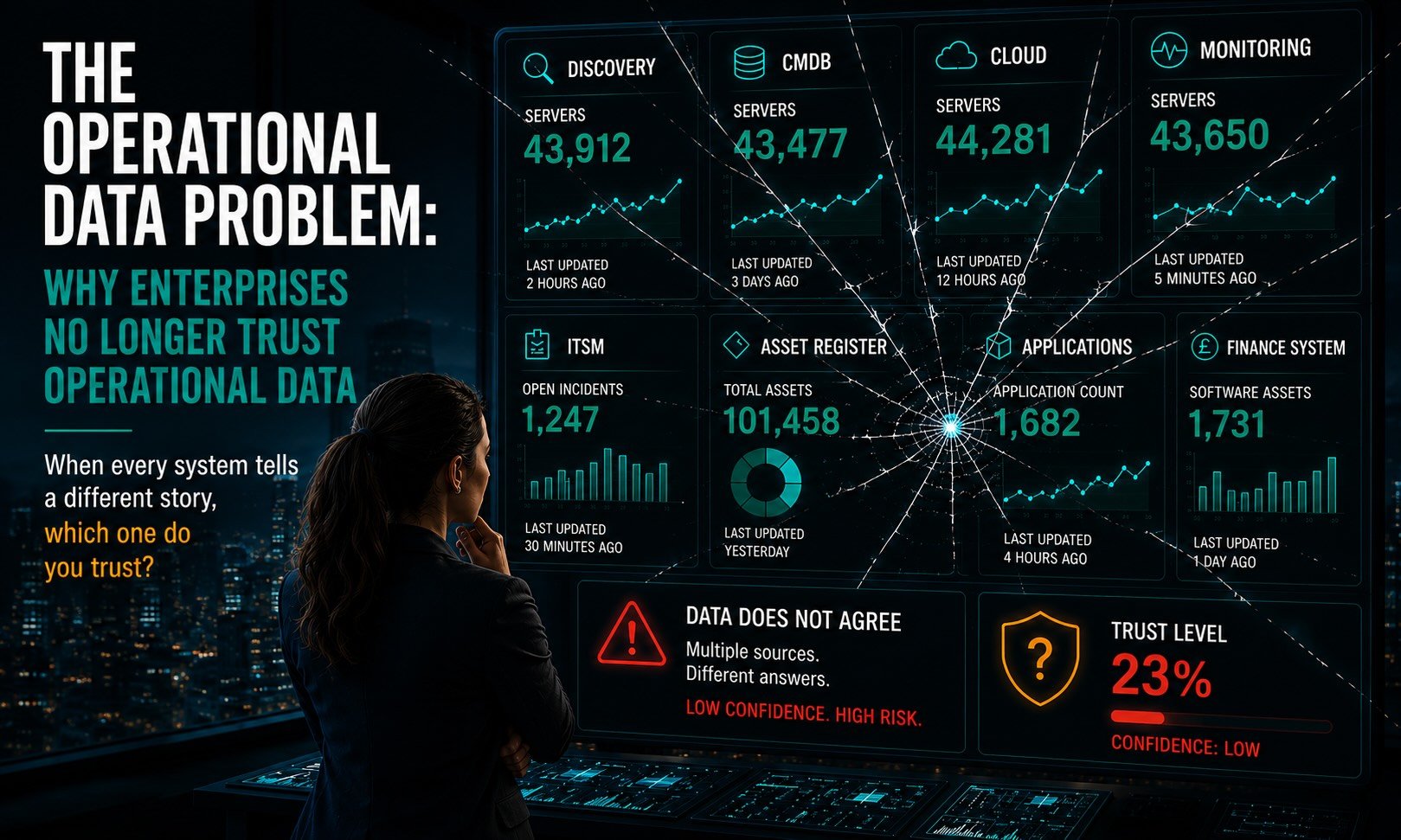
The Enterprise Data Landscape Has Become Fragmented
Today's enterprise rarely operates a single source of operational data. Instead, information is spread across:
- Discovery platforms
- CMDBs
- ITSM systems
- Cloud providers
- Network monitoring
- Endpoint management
- Asset registers
- Procurement systems
- Security platforms
- Manual spreadsheets
Every platform performs a valuable function and none of them were designed to become the definitive source of operational truth. Each discovers, stores or reports different information at different times. Eventually they begin to disagree. One system says a server exists, another says it was decommissioned, a third still believes it supports a critical business application. Nobody knows which answer is correct.
The Cost of Poor Operational Data
This isn't simply an IT problem, it has measurable business impact. According to Gartner:
- Poor data quality costs organisations an average of $12.9 million annually.
- 59% of organisations do not measure data quality, meaning many cannot quantify the scale of the problem they already have.
- Inconsistency across multiple data sources remains one of the biggest barriers to trusted enterprise data.
Those figures become even more significant when operational data drives:
- Change Management
- Incident Management
- Asset Management
- Service Mapping
- Regulatory compliance
- AI initiatives
- Executive reporting
Poor operational data doesn't just create inaccurate reports, it creates poor decisions.
Why Traditional Discovery Isn't Enough
Discovery platforms are exceptional at finding infrastructure, but discovery is only the beginning. Cloud resources change continuously, Virtual machines move, applications evolve, cloud resources appear and disappear, ownership changes, relationships drift, configuration changes. The problem is that discovery tools simply report what they see, they don't reconcile conflicting information across multiple sources, they don't continuously validate operational context, and they don't determine which source should be trusted. Over time, operational confidence begins to decline. Discovery isn't broken but operational trust is.
The Hidden Cost of Operational Drift
The challenge is that the problem doesn’t materialise in an explosive way. Most organisations don't experience a dramatic failure. Instead, confidence slowly erodes. People begin checking data manually, teams create spreadsheets, business units maintain their own inventories, service owners stop trusting the CMDB. Then projects commission new discovery exercises because nobody believes the existing information, meaning that the organisation then pays for the same information multiple times. Operational drift quietly becomes operational debt.
AI Has Raised the Stakes
This challenge has become far more significant with enterprise AI, which cannot compensate for poor operational data, it simply processes inaccurate information faster. Gartner reports that organisations achieving successful AI outcomes invest up to four times more in foundational capabilities such as data quality, governance and trusted data than organisations with poor AI results. The lesson is clear. Before organisations invest in more automation, copilots or AI agents, they need trusted operational data.
Operational Trust Requires More Than Discovery Alone
Discovery platforms don't continuously validate whether operational data remains trustworthy. Operational trust requires an additional layer. One that continuously:
- Ingests operational data
- Normalises inconsistent information
- Reconciles multiple sources
- Validates relationships
- Detects operational drift
- Highlights inconsistencies before they become business problems
That is fundamentally different from simply collecting more data.
How uControl Solves the Operational Data Problem
uControl was designed around a different principle. Rather than replacing existing enterprise investments, it supplements them. It ingests operational data from multiple systems before continuously validating and reconciling it into a trusted operational model, creating Trusted Operational Data & Service Context.
Instead of asking:
"Which system should we trust?"
IT leaders can confidently answer:
"This is the trusted operational view of our estate."
That confidence supports:
- Better executive decisions
- Faster incident resolution
- More accurate CMDBs
- Stronger regulatory compliance
- Reduced operational risk
- Lower administration costs
- AI-ready operational data
The challenge facing enterprises today isn't a shortage of operational data. It's a shortage of trusted operational data. Many organisations already own discovery platforms, monitoring tools and CMDBs. The missing capability is the continuous validation that turns fragmented operational information into trusted operational intelligence. Discovery provides visibility, monitoring provides awareness, CMDBs provide structure. uControl provides operational trust.
- A Federal Reserve Bank achieving 99.9% CMDB accuracy while eliminating over £1 million in costs and inefficiencies using uControl.
- An International Bank achieved 100% DORA compliance within five days, modelling 633 service applications and publishing 1,500 application instances using uControl.
- A Global Telecommunications Enterprise replaced an unsupported asset management platform with uControl, reducing operational overhead, improving reporting and creating a foundation for future automation, all without embarking on a large-scale CMDB transformation.
Your operational data already exists. The question is whether you trust it.
Book a personalised 30-minute uControl demonstration to see how organisations transform fragmented operational data into trusted operational insight, in minutes, not months.