
Revolut's French Banking License: The Hidden IT Challenge Behind Hypergrowth
For many organisations, traceability is still viewed as something that's only needed after an outage or before an audit.
In reality, traceability has become one of the most important foundations of operational resilience.
As organisations adopt hybrid infrastructure, cloud platforms, SaaS applications and increasingly automated IT operations, understanding what changed, why it changed, who owns it and what business services are affected has become essential.
Without that visibility, IT teams are forced to investigate incidents with incomplete information, make changes without understanding downstream impact, and struggle to demonstrate compliance with frameworks such as DORA, ISO 27001 and operational resilience requirements.
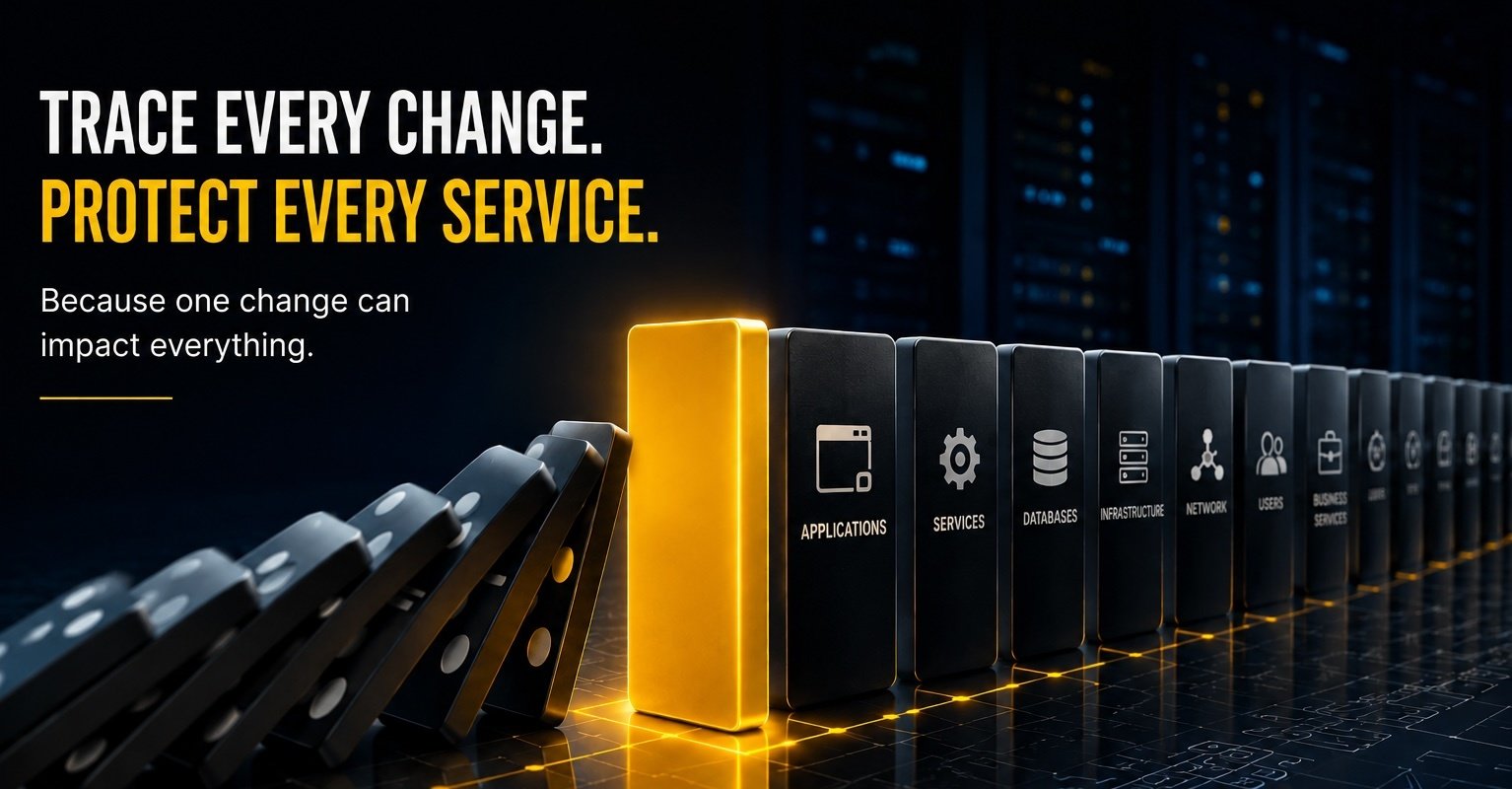
Traceability Has Changed
Traditional traceability focused on recording:
- Infrastructure changes
- Configuration history
- Change records
- Incident timelines
That is still important. But modern enterprise IT needs far more. Today's IT leaders need traceability across:
- Physical assets
- Virtual infrastructure
- Cloud services
- Business applications
- Service dependencies
- Software assets
- Ownership
- Operational risk
- Configuration drift
- Automated remediation
Traceability is no longer just an audit requirement. It is how organisations understand the operational impact of change.
Why Traditional Service Mapping Isn't Enough
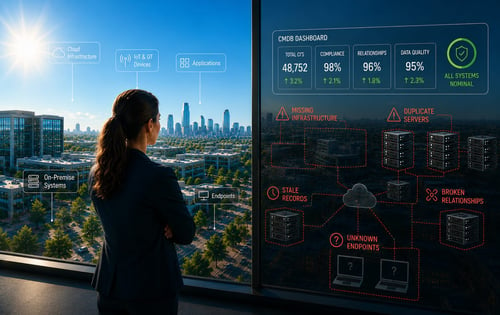
Many organisations already own discovery platforms. Many also have a CMDB. Some even have automated service mapping. Yet during a major incident they still ask questions like:
- Which business services are affected?
- Is this relationship still accurate?
- Has anything changed since the service model was created?
- Which discovery source should we trust?
- Is this application definition still correct?
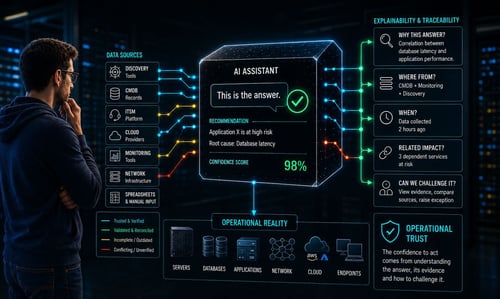
The problem is not visibility. The problem is operational trust.
Introducing Continuous Operational Traceability
TekWurx now delivers traceability through an integrated operational ecosystem. Rather than relying on a single platform, we combine best-of-breed technologies to create a continuously validated operational picture. This includes:
uControl: The operational intelligence layer that:
- Normalises data
- Reconciles multiple data sources
- Models business applications
- Maintains service relationships
- Detects configuration drift
- Continuously validates operational data
Rather than assuming data remains accurate after implementation, uControl continuously verifies that service models still represent reality.
The Power of Partnership
TekWurx has deliberately built an ecosystem around operational trust rather than replacing technologies customers already own. Today we integrate with technologies including:
- BMC Discovery
- ServiceNow Discovery
- Lansweeper
- EasyVista
- Resolve
- Existing CMDB platforms
Each partner contributes a different capability. Discovery platforms identify assets. ITSM platforms manage operational processes. Automation platforms execute actions. uControl provides the trusted operational context that connects them all.
From Traceability to Operational Intelligence
Modern traceability should answer questions instantly. Not hours later. Questions such as:
- What changed?
- When?
- Who owns it?
- Which services depend on it?
- Which environments are affected?
- What business risk has increased?
- Has the application model drifted?
- Should automation respond automatically?
This transforms traceability from a reporting function into an operational decision-making capability.
Business Benefits
Organisations adopting this approach achieve:
- Faster root cause analysis
- Better change success rates
- Improved DORA readiness
- Stronger audit evidence
- Reduced MTTR
- Improved service ownership
- Greater confidence in CMDB accuracy
- Earlier detection of operational drift
- Better support for AI-driven operations
Traceability Is One Pillar of Operational Excellence
At TekWurx, traceability is one of the Four Pillars of Operational Excellence. Together they provide a complete operational foundation:
Visibility — Discover everything.
Trust — Ensure operational data is accurate.
Traceability — Understand relationships, ownership and change.
Control — Turn trusted insight into automated action.
Individually each pillar delivers value. Together they eliminate uncertainty in IT operations.
Enterprise IT is becoming more dynamic every year. Cloud adoption, automation and AI are accelerating the pace of operational change. Simply recording changes is no longer enough. Modern organisations need continuous operational traceability that combines trusted data, accurate service models, real-time visibility and intelligent automation.
By bringing together uControl, uControl Insights and a carefully selected ecosystem of technology partners, TekWurx enables organisations to move beyond service mapping and towards complete operational confidence.
Because the organisations that can explain what changed, why it changed, and what it means to the business are the organisations best equipped to operate securely, comply confidently and innovate faster.
Move Beyond Traditional Service Mapping
If your organisation already owns discovery tools, a CMDB or an ITSM platform, the next challenge isn't collecting more data, it's ensuring that data remains trusted, connected and actionable.
Book a personalised, 30-minute demonstration to see how uControl, and the TekWurx partner ecosystem deliver continuous operational traceability, trusted service context and intelligent operational control across your IT estate