

The Hidden Cost of Specialist-Dependent Platforms
For years, financial institutions have invested heavily in digital transformation, cloud migration, cyber security, observability and automation. Yet many organisations continue to face the same operational challenge:
They cannot fully trust the data that powers their IT operations.
As regulatory scrutiny increases, cyber threats become more sophisticated, and operational resilience moves from a technical objective to a board-level priority, trusted operational data is becoming a competitive differentiator.
In 2026, the organisations that can confidently answer questions such as:
- What assets support this service?
- What will be impacted if this system fails?
- Which business applications rely on this infrastructure?
- Can we trust the information in our CMDB?
- Are we compliant with operational resilience requirements?
will be the organisations that move faster, recover quicker and operate with less risk.
Discover: How TekWurx helped an International Bank Achieves 100% DORA Compliance in One Week, with TekWurx uControl

The Competitive Advantage Most Organisations Are Missing
The financial institutions that outperform their competitors in 2026 will not necessarily be those with the largest technology budgets.
They will be the organisations that can make faster, more confident decisions because they trust the information available to them.
When operational data is accurate:
- Incidents are resolved faster
- Changes are delivered more safely
- Compliance becomes easier
- Automation becomes more effective
- Risk is reduced
- Costs are controlled
Trusted operational data becomes a strategic asset.
And organisations that create operational trust will gain a measurable competitive advantage.
Why uControl Was Built
Most organisations already have discovery tools.
Many already have CMDBs.
Some have invested heavily in service mapping and observability platforms.
The challenge is that these tools often operate independently, creating fragmented data across the operational landscape.
uControl was developed to solve this problem.
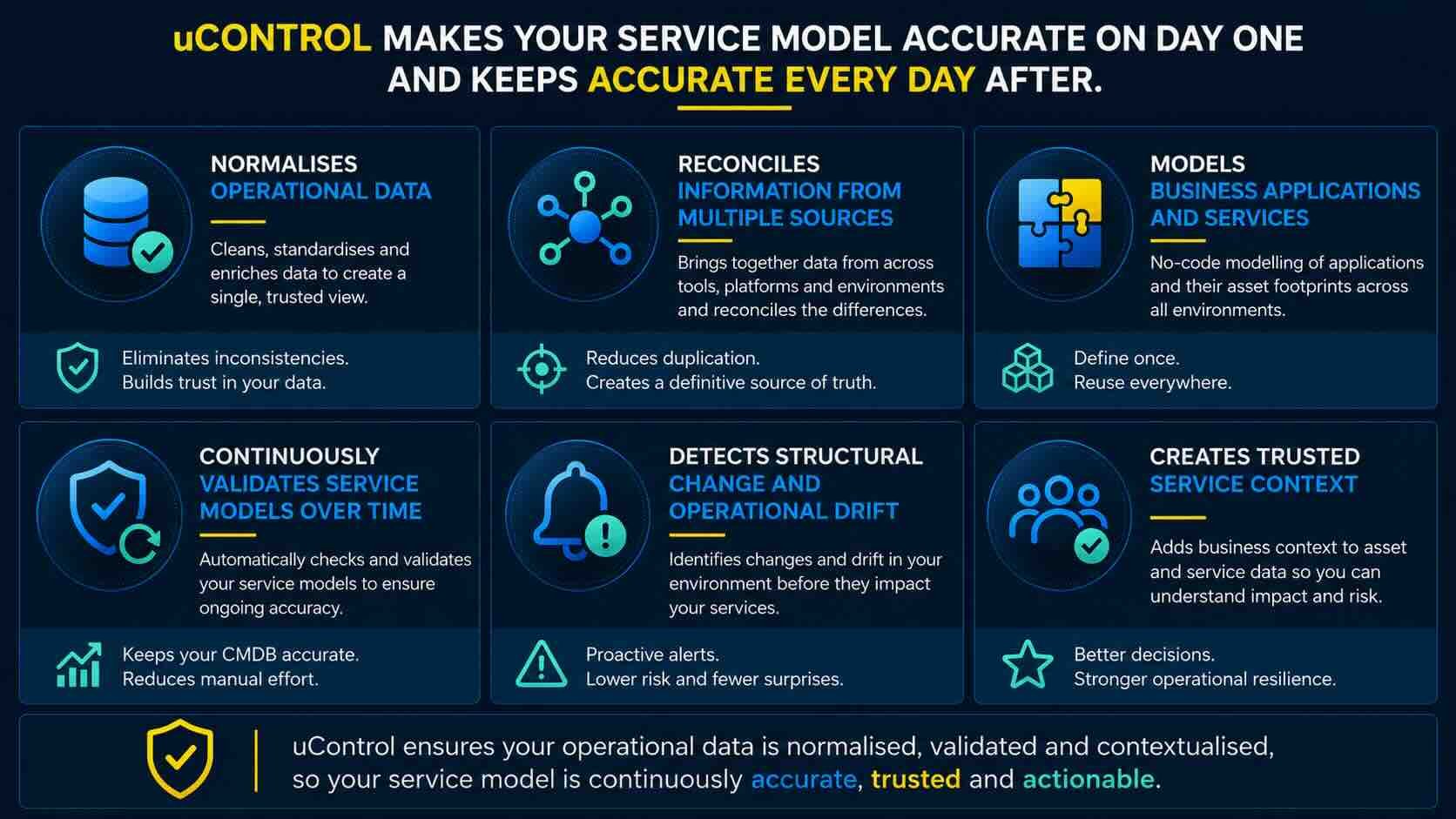
uControl is a no-code platform that:
- Normalises operational data
- Reconciles information from multiple sources
- Models business applications and services
- Continuously validates service models over time
- Detects structural change and operational drift
- Creates trusted service context
Simply put: uControl makes your service model accurate on day one and keeps it accurate every day after.

While many tools discover, store or visualise operational data, uControl focuses on ensuring that data remains trusted, contextual and actionable over time.
For financial institutions facing increasing pressure around operational resilience, cyber security, auditability and regulatory compliance, this becomes a critical capability.
Because operational resilience is not built on data.
It is built on trusted data.
Discover: How TekWurx helped an International Bank Achieves 100% DORA Compliance in One Week, with TekWurx uControl
Operational excellence is built on four foundations:
Visibility
You cannot manage what you cannot see.
Most organisations have invested in discovery tools, monitoring platforms, cloud management solutions and asset repositories. The problem is not a lack of data.
The problem is that the data exists in multiple places and often tells different stories.
Visibility provides a complete view of your technology estate, helping teams identify assets, dependencies, performance issues and operational risks before they become service-impacting incidents.
Without visibility, every decision becomes an assumption.
The Business Value of Visibility
- Faster incident detection
- Reduced downtime
- Improved cyber security posture
- Better asset utilisation
- Reduced unnecessary technology spend
- Faster root cause analysis
Visibility is the foundation.
But visibility alone is not enough.

Trust
Many organisations have a CMDB. Far fewer organisations trust it. This is where operational risk begins to emerge.
CMDBs, asset repositories and discovery platforms naturally drift over time. Data becomes duplicated, inconsistent, outdated or incomplete. When engineers lose confidence in operational data, they stop using it. We've seen this happen repeatedly during major incidents. Even when a CMDB is "mostly accurate", teams will often revert to tribal knowledge, spreadsheets and manual investigation because they cannot afford uncertainty when services are down.
The result is slower decision-making, longer outages and increased operational risk.
The Business Value of Trust
- Higher change success rates
- Reduced operational waste
- More accurate forecasting and budgeting
- Stronger audit outcomes
- Improved operational resilience
- Greater confidence during critical incidents
Trust is not created by collecting more data.
Trust is created by ensuring operational data remains accurate, contextual and continuously validated.

Traceability
Modern financial services environments are incredibly complex.
Applications depend on databases.
Databases depend on infrastructure.
Infrastructure depends on cloud services.
Changes made in one area can have significant consequences elsewhere.
Traceability connects technology assets to the business services they support.
It allows organisations to understand:
- Service dependencies
- Ownership
- Risk exposure
- Business impact
- Regulatory obligations
Without traceability, impact analysis becomes guesswork.
With traceability, organisations can make informed decisions with confidence.
The Business Value of Traceability
- Faster root cause analysis
- Improved impact assessment
- Better cost control
- Reduced transformation risk
- Stronger governance
- Improved operational resilience

Control
Visibility tells you what exists.
Trust tells you whether the information is accurate.
Traceability tells you why it matters.
Control allows you to act.
Organisations that excel operationally are increasingly automating repetitive processes, proactively identifying risks and reducing manual effort across IT operations.
Control transforms operational insight into measurable business outcomes.
The Business Value of Control
- Reduced support costs
- Improved productivity
- Faster incident resolution
- Increased automation
- Greater operational consistency
- Scalable IT operations
Control is where operational data begins to create commercial value.

How Much Risk Is Hidden Inside Your CMDB?
Many organisations assume their CMDB is helping reduce risk.
In reality, inaccurate, incomplete or outdated CMDB data often introduces additional operational risk, slows incident response and creates hesitation during critical decision-making.
That's why TekWurx created the CMDB Risk Calculator.
In less than five minutes, you can assess:
- The trustworthiness of your CMDB
- Potential operational risk exposure
- Areas of concern across visibility, trust, traceability and control
- The likely impact inaccurate operational data could be having on your organisation
Calculate Your CMDB Risk Score Today
Take the TekWurx CMDB Risk Calculator and discover whether your CMDB is reducing risk or creating it.